


To find agriculture companies and contact their legal or compliance teams, start with a defined career goal and a verified employer list.
Read current vacancies, identify the relevant department, and use the organization’s preferred application channel.
Professional contact research is useful when you have a specific question that the posting leaves unanswered.
Agricultural employers include producers, cooperatives, equipment businesses, food processors, and agricultural technology firms.
Their legal support arrangements can differ.
Some employ an internal legal team; others use external counsel or distribute compliance work across several departments.
Research the employer’s actual structure before assuming a particular job exists.
Define the Role Before Choosing Employers
Decide whether you are looking for legal support, contracts work, compliance administration, or an attorney position.
Read the responsibilities and qualifications in actual postings.
Similar titles can describe different levels of responsibility.
Use your education and work history to identify roles you can reasonably apply for.
A directory of Agriculture Companies can provide names and locations for an initial employer list.
Verify each business through its own website and careers page.
An industry listing is a research starting point; it does not establish that a company has an internal legal department or an open vacancy.
For example, someone with document-management experience might investigate contracts administration or legal operations support.
A posting requiring a law license needs a different qualification check.
Keep questions about licensing and professional eligibility with the relevant regulator or qualified adviser rather than inferring requirements from a job title.
Check the Business Before Researching Individual Employees
Read what the company produces, where it operates, and which entities appear on its careers page.
A familiar brand may use a different legal employer for a vacancy.
Record the employer named in the posting, the location, and the job reference.
Those details help prevent messages reaching the wrong team.
Look for the careers page’s own application and contact instructions.
A general customer-service address may have little connection to recruiting.
If you cannot find an appropriate opening, save the employer for a later review.
A company being relevant to your interests is different from having a role to fill today.
- Record the employer name and official website.
- Save the vacancy URL, location, and job reference.
- Note the department and reporting relationship where stated.
- Separate confirmed facts from unanswered career questions.
Match the Question to the Right Department
The right recipient depends on what you need to know.
A recruiting contact may clarify an application stage.
A legal operations manager may discuss the team’s work in an informational conversation.
A compliance vacancy may sit outside the legal department.
Read the posting before assigning responsibility to a general counsel.
Use current team pages and professional profiles to check names and roles.
A Chrome contact details finder can help surface a professional contact channel after you have identified a relevant person.
Verify the employer and identity before using the result.
Finding an address does not confirm hiring responsibility or an invitation to call.
Keep the question narrow.
Asking which channel handles applications for a named role is easier to route than sending an unsolicited résumé to several senior lawyers.
Follow any instruction that directs candidates to the application portal or asks them not to contact employees about the vacancy.
Read the Vacancy as a Description of Work
List the tasks the posting actually names.
These might include maintaining contract records, coordinating documents, tracking internal approvals, or supporting a compliance team. Match your examples to the published tasks.
Avoid implying that administrative experience qualifies you to perform legal work beyond the role’s stated scope.
Legal Career Path’s compliance officer career guide can help readers investigate that profession further.
For a particular application, the employer’s requirements remain the relevant starting point.
Check the qualifications, level of responsibility, location, and application materials before deciding whether to invest time in the role.
A useful application example describes what you did and how you handled the records or task.
Someone who maintained a document register could explain the volume, review process, and correction steps.
Remove confidential client details.
Do not send work samples you lack permission to share.
Write a Professional Inquiry With a Clear Purpose
Identify the vacancy and explain the specific reason for your question.
If you have already applied, say so accurately.
Ask for information that is absent from the posting, such as which office handles a listed role.
Avoid requesting an interview before the recipient knows which vacancy you mean.
For an informational conversation, describe the area you are researching and ask whether the person is open to a short discussion.
Make clear that you are seeking career information.
An employee may be able to discuss their profession without being involved in recruitment or authorized to assess your application.
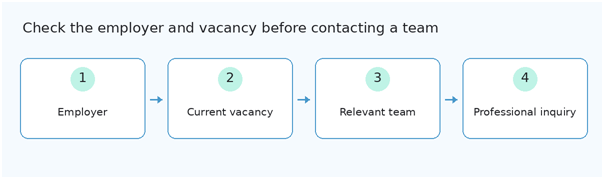
- Confirm the employer and vacancy on the official site.
- Check that your qualifications match the published requirements.
- Choose the designated application or professional inquiry channel.
- Send one specific question and record the response.
- Update the employer record before considering a follow-up.


Leave Your Comment