

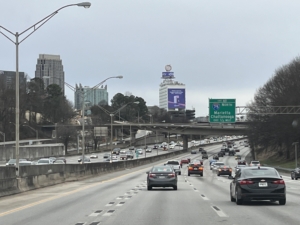
Georgia police logged 371,130 crashes in 2024, according to preliminary data from the Governor’s Office of Highway Safety, and about 105,500 of them left someone hurt or killed.
In Atlanta, I-75 carries roughly 405,000 vehicles a day, more than any other stretch of road in the country, per the Federal Highway Administration.
An injury claim largely rises or falls on the records gathered in the first few weeks.
The at-fault driver’s insurer starts building its own version of events almost immediately and treats any gap in your paperwork as a reason to pay less.
The steps below run in order, from the police call to settlement talks.
Call the Police and Get the Crash Report
Georgia law requires drivers in a crash to stop, share their name, address, and registration number, and help anyone injured (O.C.G.A. § 40-6-270).
A crash with injuries or apparent damage of $500 or more must be reported to police immediately (O.C.G.A. § 40-6-273).
The police report is usually the first document an adjuster opens.
The officer’s diagram and violation notes shape the early view of fault, which also makes the report the starting point for the car injury attorneys Atlanta drivers call after a collision.
They check it against photos and witness statements.
Inside city limits, the Georgia State Patrol works interstate crashes on weekdays from 6 a.m. to 8 p.m., and the Atlanta Police Department handles the rest.
APD reports cost $11 on BuyCrash and are posted within 5 to 7 business days, so note the report number and the officer’s name at the scene.
See a Doctor and Keep Up With Treatment
Don’t put off a medical exam, even if you feel fine.
Whiplash symptoms most often appear within days, according to Mayo Clinic, and some internal injuries take even longer to show up.
Insurers also track how consistent your treatment is.
Claims software like Colossus compares visit dates with the crash date, and the legal guide Nolo warns that a two-week wait before seeing a doctor is a gap you’ll have to explain.
Adjusters read any break in care as a sign the injury healed or came from something else.
Keep every medical bill and explanation of benefits (EOB) from day one.
For crashes on or after April 21, 2025, O.C.G.A. § 51-12-1.1 lets jurors see both what was billed and what was actually needed to pay those bills when the injured person has health insurance.
Preserve Evidence Before It Disappears
Some evidence vanishes within days, so it makes sense to collect it while you’re still in treatment.
- Photos of both cars, the intersection, skid marks, and your injuries in the first few days
- Names and phone numbers of witnesses
- The other driver’s insurance company and policy number
- Nearby stores and gas stations that may have cameras, since private businesses often record over footage within days
- Your car, unrepaired
GDOT traffic cameras won’t help, because the agency doesn’t record their video.
Under Georgia’s retention schedule, local governments keep surveillance footage for 30 days, or until claims settle if they know about an incident, so send a written preservation request right away.
An event data recorder (EDR), if the car has one, logs speed and braking for about five seconds before impact, so don’t repair or scrap the car before it’s inspected.
In Phillips v. Harmon, the Georgia Supreme Court held that the duty to preserve evidence applies to injured people too once they contemplate a lawsuit.
Be Careful When You Talk to Insurers
Georgia’s Office of Insurance and Safety Fire Commissioner advises reporting the crash to your own insurer as soon as possible, even if the other driver caused it.
Your policy’s duty to cooperate applies only to your own company, so you don’t owe the at-fault driver’s insurer a recorded statement.
The other side’s adjuster usually calls within days, and an offhand “I’m fine” can later be quoted as an admission.
A broad medical authorization opens your whole medical history, and a general release can end claims for injuries you don’t know about yet.
The first offer often arrives before anyone knows what treatment will cost.
Check your own policy, too.
Georgia’s minimum liability coverage is $25,000 per person and $50,000 per crash for injuries, plus $25,000 for property (O.C.G.A. § 33-34-4, § 40-9-37), and the Insurance Research Council estimates that 19% of the state’s drivers carry no insurance.
Uninsured/underinsured motorist (UM/UIM) coverage can fill the gap (O.C.G.A. § 33-7-11).
By default, it pays on top of the at-fault driver’s limits, and it can only be waived in writing.
Watch the Deadlines and Understand How Fault Is Split
You have two years from the crash to file an injury lawsuit (O.C.G.A. § 9-3-33) and four years for a vehicle damage claim (§ 9-3-31).
Claims against a city need a written ante litem notice within six months (§ 36-33-5).
Counties and the state allow 12 months (§ 36-11-1, § 50-21-26).
Georgia splits fault by percentage.
If your share reaches 50% or more, you recover nothing.
Below that, your award shrinks in proportion to your share (O.C.G.A. § 51-12-33).
In lawsuits filed on or after April 21, 2025, the defense can also point to an unbuckled seat belt (§ 40-8-76.1(d)).
How the Documents Add Up to a Strong Case
A strong case rests on documents that back each other up: the police report, medical records with no gaps, photos from the day of the crash, and insurer correspondence without careless admissions.
Together they form the basis of the pre-suit settlement demand, which under O.C.G.A. § 9-11-67.1 includes your medical records and gives the insurer at least 30 days to respond.



Leave Your Comment