

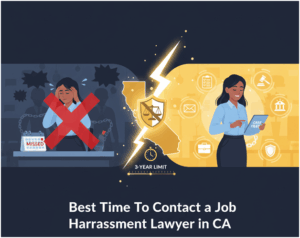
Workplace harassment can leave you feeling isolated, powerless, and unsure of your next steps.
You might ask yourself, “Is this behavior illegal, or just rude?” or “Will I get fired if I report it?”
For many California employees, the fear of retaliation often delays necessary legal action until significant damage has already been done to their careers and mental health.
This is not an uncommon experience; in fact, between 2016 and 2023, over a third of all discrimination charges filed with the EEOC included an allegation of harassment, according to data published by Woods Rogers.
Knowing exactly when to escalate a situation from an internal HR complaint to a legal consultation is critical.
California maintains some of the strongest employee rights protections in the country, but these protections rely on your ability to recognize unlawful behavior and act within specific timelines.
Whether you are currently facing a hostile work environment or suspect you were the victim of a wrongful termination, understanding the best time to seek legal help is the first step toward reclaiming your power.
Understanding Workplace Harassment Under California Law
Not every unpleasant interaction at work qualifies as illegal workplace harassment.
In California, the definition is governed by specific criteria under the state’s robust labor laws, primarily the Fair Employment and Housing Act (FEHA).
To be legally actionable, the behavior must be unwelcome and based on a protected characteristic.
Furthermore, it must be either “severe” (a single act so egregious it alters the work environment) or “pervasive” (a pattern of repeated conduct that creates an intimidating, hostile, or offensive atmosphere).
What Legally Qualifies as Workplace Harassment in California
Under the FEHA, specifically Government Code § 12940(j), illegal harassment goes far beyond general bullying or personality conflicts.
It involves unwelcome conduct that creates a hostile, intimidating, or offensive work environment because of a person’s protected status.
This can manifest in several ways:
- Verbal Abuse: This includes slurs, derogatory jokes, epithets, and offensive comments about a person’s protected traits.
- Physical Conduct: Unwanted touching, assault, physical intimidation, or blocking someone’s movement.
- Visual Harassment: Displaying offensive posters, cartoons, drawings, or sending offensive emails and text messages.
The key is the motivation behind the conduct; it must be linked to a protected characteristic to fall under the harassment law.
Differences Between Harassment, Discrimination, & Hostile Work Environment
While these terms are often used interchangeably in conversation, they have distinct legal meanings under California employment law:
- Harassment: This refers to the unwelcome conduct based on a protected trait, such as a supervisor making racially charged jokes or a coworker making unwanted sexual advances. The focus is on the behavior itself.
- Workplace Discrimination: This involves an adverse employment action taken because of a protected trait. Examples include being fired, demoted, denied a promotion, or having your pay cut because of your age, race, gender, or disability.
- Hostile Work Environment: This is a specific type of harassment. It occurs when the harassing conduct is so severe or pervasive that it alters the conditions of employment and creates an abusive atmosphere for the employee. A few isolated incidents may not qualify, but a consistent pattern of verbal abuse often will.
Quid Pro Quo Harassment vs Hostile Work Environment
Sexual Harassment in California generally falls into two primary categories, each with different legal elements:
- Quid Pro Quo (Latin for “this for that”): This occurs when a manager, supervisor, or another person in a position of power conditions an employment benefit on the receipt of sexual favors. For instance, a manager suggesting a promotion is contingent on going on a date. A single incident can be enough to create a valid legal claim.
- Hostile Work Environment: This form of harassment doesn’t require a direct threat or threat. Instead, it involves a pattern of unwelcome sexual conduct, such as explicit jokes, comments about an employee’s body, or displaying pornographic material, that is severe or pervasive enough to make the workplace intimidating, offensive, or unbearable.
Protected Classes Under FEHA
California employment law provides broad protections against harassment.
It is illegal for an employer to harass an employee based on their:
- Race, color, national origin, and ancestry
- Religion and creed
- Gender, gender identity, gender expression, and sexual orientation
- Marital status
- Medical condition (cancer-related or genetic characteristics)
- Disability (both mental and physical)
- Military or veteran status
- Age (if over 40)
- Pregnancy, childbirth, or related medical conditions
When “Unfair Treatment” Becomes Legally Actionable
Being treated unfairly isn’t always illegal.
A boss who is demanding, critical, or generally rude to everyone indiscriminately may just be a bad manager, not an illegal harasser.
The treatment crosses the line into legally actionable harassment when it is motivated by a protected characteristic.
For example, if a manager consistently assigns undesirable tasks only to the women on the team or criticizes older workers for being “slow” while praising younger ones, that targeted unfair treatment likely constitutes illegal workplace discrimination and harassment.
Common Workplace Behaviors that Signal Harassment but Are Often Overlooked
Harassment isn’t always loud, obvious, or aggressive.
Subtle, insidious behaviors can be just as damaging and are often precursors to more overt misconduct.
These can include:
- Microaggressions: Backhanded compliments or subtle insults related to your background, race, or gender (e.g., “You’re so articulate for someone like you”).
- Exclusion: Consistently being left out of important meetings, email chains, or social events where your peers are included.
- Sabotage: Being given impossible deadlines, insufficient resources, or misleading information intended to make you fail.
- Inappropriate Personal Questions: Intrusive questions about your private life, medical history, or religious beliefs that have no relevance to your job.
Red Flags that Harassment Will Escalate
Harassment rarely stays at one level; it often escalates if left unchecked.
Key warning signs that the situation is likely to worsen include:
- Dismissiveness from Management: Your initial complaints are brushed off as “just a joke,” or you’re told you’re being “too sensitive.”
- Emboldened Harasser: The person engaging in the harassment faces no consequences and becomes more aggressive or frequent in their behavior.
- Pretextual Criticism: Suddenly, after you complain, you start receiving negative feedback on your work for the first time. This is often a prelude to a retaliatory wrongful termination.
Key Signs It’s Time to Speak With a California Employment Attorney
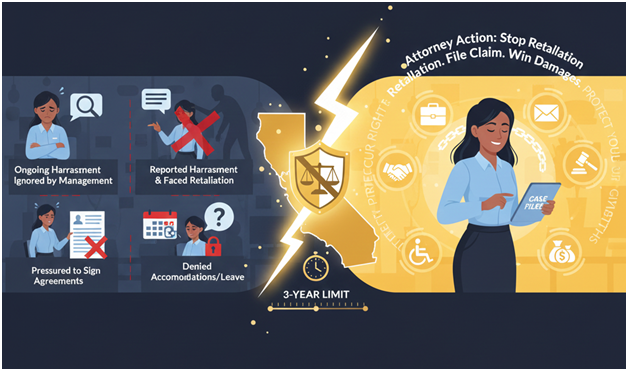
If you are trying to decide whether your situation warrants legal intervention, consider the following scenarios.
These are strong indicators that you need professional advocacy from an experienced employment attorney.
You Are Experiencing Ongoing Harassment that Management Ignores
You followed the company’s employee handbook.
You documented the behavior and reported it to HR or your direct supervisor.
Yet, weeks have passed, and the conduct continues, or has even gotten worse.
When an employer is aware of harassment and fails to take immediate and appropriate corrective action, it can be held liable for the conduct.
This inaction signals that the internal system has failed, and it’s time to explore your external legal rights.
You Reported Harassment and Faced Retaliation
Retaliation is one of the most common types of employment law violations.
If you reported misconduct and were subsequently demoted, given a suddenly negative performance review, moved to a less desirable location in Los Angeles, or had your hours cut, you likely have a strong retaliation claim.
California law strictly prohibits employers from punishing employees for engaging in protected activities, which include complaining about harassment or workplace discrimination.
You Fear Termination if You Speak up Against Your Employer
Fear is a powerful silencer.
If the workplace culture is so toxic that you genuinely believe reporting illegal behavior will cost you your job, it is a clear sign that you need external legal counsel.
An employment attorney can advise you on how to document the issue, report it in a way that maximizes your legal protections, and strategize next steps without immediately jeopardizing your livelihood.
Employer Denies Leave, Accommodations, or Creates Barriers
If you are being harassed due to a disability, medical condition, or pregnancy, and your employer subsequently denies you reasonable accommodations or legally protected medical leave (under FMLA/CFRA), this creates a compound legal violation.
For example, a manager mocking an employee’s need for time off for medical treatments while simultaneously making it difficult to schedule that leave is a serious breach of the FEHA and the Americans with Disabilities Act.
Severe or Escalating Discriminatory Behavior
Some behavior is so egregious that a single incident is enough to warrant immediate legal action.
You do not need to prove a “pattern” of pervasive conduct.
This includes any instance of:
- The use of racial or homophobic slurs.
- Physical assault or credible threats of violence.
- Any form of sexual assault or unwanted physical touching.
- An explicit quid pro quo demand for sexual favors.
In these severe cases, waiting to see if it happens again is not a viable strategy.
You’re Being Pressured to Sign Agreements
If HR or management suddenly pressures you to sign a document you don’t fully understand, stop.
This could be a disciplinary write-up you disagree with, a new employment contract with unfavorable terms, or, most critically, severance agreements that require you to waive your right to sue in exchange for a small payment.
Never sign any such document without having it reviewed by an attorney who represents your interests, not the company’s.
You Suspect Your Employer Is Building a Case Against You
This tactic is often called “papering the file.”
After you complain about harassment, you suddenly start receiving a flurry of critical emails, negative performance reviews, or disciplinary write-ups for minor or even fabricated issues.
This is a classic strategy to create a seemingly legitimate, non-retaliatory reason for a future wrongful termination.
If you’ve had a history of positive reviews and now face constant criticism, it is a critical time to seek legal advice.
Legal Situations Where a CA Harassment Lawyer Is Absolutely Necessary
While some workplace conflicts can be resolved internally, specific legal scenarios almost always require the expertise of a seasoned California employment attorney.
Attempting to navigate these complex legal claims alone can jeopardize your case.
Hostile Work Environment Claims From Female Employees
Proving a hostile work environment requires more than just showing that a boss was mean or a coworker was unpleasant.
It requires a lawyer to help you connect individual incidents into a compelling narrative that demonstrates the conduct was severe or pervasive enough to create an abusive atmosphere that interfered with your ability to do your job.
This often involves gathering witness statements, emails, and performance data to build a strong case.
Sexual Harassment Attempt at Workplace
Sexual Harassment cases are often deeply personal and complex, frequently involving “he-said, she-said” dynamics where credibility is key.
Whether you are dealing with unwanted touching, explicit text messages, or quid pro quo demands for sexual favors, an experienced attorney ensures that your story is supported by evidence, that your employer is held accountable for failing to prevent the behavior, and that your privacy is protected throughout the process.
Wrongful Termination Tied to Reporting Misconduct
If you were fired shortly after reporting harassment or discrimination, the timing itself is powerful circumstantial evidence of retaliation.
However, your employer will almost certainly provide a different, seemingly legitimate reason for the termination, such as “poor performance” or “corporate restructuring.”
A lawyer is essential to challenge this pretext and link your firing directly to your protected activity, proving a wrongful termination.
Wage Retaliation after Filing a Complaint Against the Employer
Retaliation doesn’t always mean being fired.
It can also be financial.
If your sales territory is suddenly changed, your commission structure is altered, you are denied overtime opportunities, or your bonuses are withheld right after you file a harassment complaint, this is a form of illegal retaliation.
An attorney can help you file a wage and hour claim to recover these lost earnings in addition to your harassment claim.
Constructive Discharge from Your Employment
If your employer knowingly allows working conditions to become so objectively intolerable that any reasonable person in your position would feel forced to resign, it is known as “constructive discharge” or “constructive termination.”
Legally, this is often treated the same as a wrongful termination.
However, these are exceptionally difficult cases to prove without an attorney’s help to demonstrate that you exhausted all reasonable options before quitting.
Discrimination Tied to Race, Gender, Religion, Disability, Pregnancy, Age
Harassment is often the method through which illegal workplace discrimination is carried out.
If you are being targeted with harassment specifically because you belong to a protected class, for example, older workers being mocked as “dinosaurs” to push them out, or pregnant employees being ostracized, you have overlapping harassment and discrimination claims that strengthen each other.
Retaliation for Whistleblowing or Refusing Illegal Actions
If the harassment you are facing stems from your refusal to participate in illegal activities or from reporting safety violations or fraud (whistleblowing), you have distinct legal protections under California Labor Code Section 1102.5.
These cases require a lawyer who understands the specific nuances of whistleblower retaliation harassment law.
Harassment by Supervisors, Owners, or High-Ranking Staff
When the harasser is a supervisor, California employment law holds the employer strictly liable for their actions in many quid pro quo cases.
When the harasser is an owner or a high-level executive, internal reporting channels like HR are often compromised or entirely ineffective.
In these situations, seeking external legal help is frequently the only viable path to justice.
Harassment that Affects Your Mental/Physical Health
If the abuse at work has led to documented anxiety, depression, PTSD, or physical ailments requiring medical treatment, you may be entitled to significant damages for emotional distress.
An attorney is crucial for properly valuing these damages and presenting the medical evidence needed to support your claim for pain and suffering.
Evidence to Gather Before Contacting a Lawyer
To build the strongest possible case, documentation is your most powerful tool.
Before you consult with a Los Angeles attorney for job harassment, try to gather and organize the following items:
- Emails, Texts, and Messages: Save any digital communication that demonstrates the harassment or shows you reported it. Take screenshots and forward copies to a personal email address, as you may lose access to company systems.
- Notes and Journals: Maintain a detailed personal log. For each incident, document the date, time, location, what was said or done, who was present, and how it made you feel. Be specific.
- Performance Reviews: Keep copies of past positive performance reviews and any accolades you’ve received. These are invaluable for countering any sudden claims of “poor performance.”
- Employer’s Handbook: Secure a copy of the company’s policies on harassment and reporting procedures. This can be used to show that the company failed to follow its own rules.
- Witness Information: Identify coworkers who witnessed the harassment and may be willing to speak about what they saw. Do not pressure them, but have their contact information available for your attorney.
- Paystubs and Financial Records: These are essential for calculating lost wages if you were demoted, had your hours cut, or were wrongfully terminated.
When You Should Contact a Lawyer Even Without Solid Evidence
Do not let a lack of a “smoking gun” email or a recording stop you from seeking legal help.
An experienced employment attorney knows how to build a case even with limited physical evidence.
You should still seek a consultation if:
- The harassment happened privately with no witnesses.
- You believe your employer has deleted or destroyed relevant records.
- HR refused to provide you with a copy of your written report.
- The retaliation was subtle, like social exclusion or the “silent treatment.”
Your own credible testimony is a powerful form of evidence.
A skilled lawyer can use legal tools like depositions and subpoenas to uncover the evidence you couldn’t access on your own.
How a California Harassment Lawyer Helps Protect You
Hiring a lawyer who specializes in workplace harassment dramatically shifts the power dynamic from your employer back to you.
They become your advocate, strategist, and shield.
Here is how they actively protect your interests and legal rights.
Reviewing Your Case and Determining if CA Law Was Violated
First, an attorney will carefully analyze the facts of your situation against the complex nuances of California’s FEHA and other relevant labor laws.
They have the expertise to distinguish between behavior that is merely unprofessional and behavior that is illegal, giving you a clear assessment of whether you have a viable legal claim.
Explaining Your Legal Options
A lawyer will clearly lay out your potential paths forward.
This includes explaining the difference between filing an administrative claim with a government agency and filing a civil lawsuit.
In California, you typically must first file a complaint and obtain a “Right-to-Sue” notice from the California Civil Rights Department (CRD), a critical procedural step that your lawyer will handle on your behalf.
Filing Your Claim with DFEH/CRD or EEOC
Deadlines in employment law are strict and unforgiving.
An attorney ensures your complaints are drafted correctly and filed with the appropriate state or federal agencies, the California Civil Rights Department (CRD, formerly the DFEH) or the federal Equal Employment Opportunity Commission (EEOC), within the statutes of limitations, preserving your right to pursue justice.
Stopping Retaliation and Communicating on Your Behalf
Once you have legal representation, your attorney will typically send a letter of representation to your employer.
This action alone often puts an immediate stop to direct harassment and further retaliation, as the company knows it is now under legal scrutiny.
From that point on, your lawyer handles all communication, protecting you from direct contact with HR or management.
Negotiating Compensation Directly with the Employer First
Your attorney’s primary goal is to secure full and fair compensation for the damages you have suffered.
This may include:
- Lost Wages: Both past and future income lost due to harassment, retaliation, or termination.
- Emotional Distress: Compensation for the pain, suffering, anxiety, and mental anguish caused by the illegal conduct.
- Punitive Damages: In cases of malicious conduct, these damages are intended to punish the employer and deter future misconduct.
- Attorney’s Fees: In many cases, the employer can be required to pay your legal fees.
Collecting Evidence and Legal Strategy
Lawyers have powerful discovery tools that you do not.
They can issue subpoenas to obtain company emails, security footage, personnel files, and internal investigation reports.
They will take depositions of the harasser, supervisors, and other witnesses under oath.
This evidence is used to build a comprehensive strategy for settlement negotiations or, if necessary, for trial.
Harassment Situations Require Instant Legal Action
In some cases, waiting to see if things improve is not just risky, it’s detrimental to your case and your well-being.
You should contact a California Workplace Harassment Lawyer immediately if any of the following apply:
- You were physically threatened, assaulted, or intimidated.
- Your employer retaliated against you within days of your complaint (e.g., you were fired, demoted, or suspended).
- You were just handed a notice of wrongful termination.
- Your employer is pressuring you to sign a severance agreement or a non-disclosure agreement (NDA).
- HR has officially closed its investigation without taking meaningful action or has refused to investigate your claims at all.
- The harassment is causing a severe decline in your mental or physical health.
- You are being systematically isolated, sabotaged, or set up to fail.
If you are in Los Angeles or anywhere in California and facing one of these situations, securing immediate legal help is the most critical step you can take to protect your rights and your future.
Frequently Asked Questions
What Evidence Is Needed to Prove a Hostile Work Environment in California?
To prove a hostile work environment, you need evidence demonstrating that the harassment was
- based on a protected characteristic (like race, gender, or disability).
- Severe or pervasive enough to create an abusive atmosphere that a reasonable person would find hostile.
Key evidence includes your own detailed notes, emails, and text messages, witness testimony, performance reviews showing a pattern of good work before the harassment, and proof that your employer knew about the conduct but failed to take corrective action.
What Qualifies as Workplace Harassment under CA Law?
Under California’s Fair Employment and Housing Act (FEHA), illegal workplace harassment is unwelcome conduct that is based on a protected status (such as age, disability, sexual orientation, or religion).
It can be verbal (slurs, epithets), physical (unwanted touching, assault), or visual (offensive images, cartoons).
General rudeness or bullying not tied to a protected class is typically not illegal, though it may violate company policy.
What Are the Odds of Winning a California Harassment Lawsuit?
The success of any lawsuit depends heavily on the specific facts and the quality of the evidence.
However, California’s employment law, particularly the FEHA, offers some of the strongest employee protections in the nation, often making it more favorable for employees to prove harassment compared to federal standards.
An experienced employment attorney can provide a realistic assessment of your case’s strengths and weaknesses during a confidential consultation.
How Much Is a Typical Harassment or Discrimination Case Worth in California?
There is no “average” settlement or verdict, as the value of a case varies dramatically based on factors like the amount of lost wages, the severity and duration of the harassment, the egregiousness of the employer’s conduct, and the extent of the emotional distress suffered.
Cases can range from tens of thousands of dollars to, in severe instances where punitive damages are awarded, well over a million dollars.
Can You Sue Your Employer for Emotional Distress from Harassment?
Yes.
In California, if workplace harassment has caused you to suffer significant anxiety, depression, sleeplessness, or other forms of mental anguish, you can seek damages for emotional distress.
These are often a significant component of a harassment claim.
Testimony from you, your family, and medical records or therapist notes are commonly used to support these claims.
How Long Do You Have to File a Workplace Harassment Claim in CA?
The statutes of limitations are critical.
Generally, you have three years from the date of the last incident of harassment or discrimination to file an administrative complaint with the California Civil Rights Department (CRD).
The timelines to file with the federal Equal Employment Opportunity Commission (EEOC) are often shorter (usually 300 days).
Missing these deadlines can permanently bar you from seeking justice.
What should I do if HR ignores my harassment complaint?
If HR ignores your complaint, it is a major red flag that the company is failing its legal duty to address the issue.
Your first step should be to document their lack of response in writing (e.g., a follow-up email creating a paper trail).
Your next, and most important, step should be to consult with an employment attorney.
HR’s failure to act can actually strengthen your legal case against the company.
Should I Talk to a Lawyer if I’m Being Pushed to Quit My Job?
Absolutely, yes.
This is a classic example of “constructive discharge.”
If your employer is deliberately making your working conditions so intolerable that you feel you have no choice but to resign, you should speak to an attorney before you quit.
An attorney can advise you on whether you have met the high legal standard for a constructive discharge claim and help you strategize your exit in a way that preserves your right to sue for wrongful termination.


Leave Your Comment