

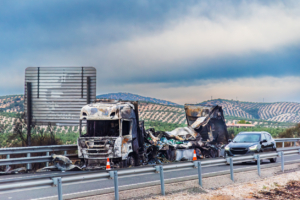
Law students who picture plaintiff-side personal injury work often imagine something tidy.
Two drivers, two insurance policies, a settlement check.
Truck accident litigation rarely looks like that.
When a commercial truck hurts someone, the case that follows runs on federal regulations, races against a clock that erases evidence, and names a chain of businesses instead of a single driver.
For anyone weighing this corner of the legal field, the work is worth understanding before the first file lands on the desk.
Texas makes a useful study.
The state moves more freight by road than any other, and the crash numbers follow the traffic.
Federal Motor Carrier Safety Administration data puts Texas at the top of the country for fatal crashes involving large trucks, ahead of California in second place.
A loaded tractor-trailer can weigh up to 80,000 pounds, roughly twenty times a midsize car, so the person who gets hurt almost always sits in the smaller vehicle.
Those facts shape every case a truck accident lawyer takes on.
A Truck Wreck Is Not a Bigger Car Wreck
A passenger car claim usually involves two drivers and two policies.
Truck cases rarely stay that small, and the reason is structural.
A commercial truck is a business asset.
A driver operates it, but that driver answers to a carrier, hauls freight someone else loaded, and runs a schedule someone else set.
Each relationship can shape who caused the crash.
So a truck case opens as an investigation rather than a quick call to an adjuster.
Lawyers who handle this work spend their early hours collecting records, not negotiating.
The size gap raises the stakes, too.
Injuries run worse, medical bills climb higher, and the dollar figures pull in defense lawyers and insurers who push back hard from day one.
New attorneys often meet seasoned opposing counsel faster in this practice than in almost any other plaintiff-side work.
The Crash Report Is a Starting Point
After a wreck in Texas, an officer files a crash report on the form known as the CR-3.
It records the basics: where the vehicles ended up, who got cited, and what the driver said at the scene.
That report matters, but it reads like a first draft.
Officers reconstruct the crash after the fact, often without the truck’s data, the driver’s logs, or the carrier’s maintenance records.
A report that looks clean for the trucking company can shift once deeper evidence surfaces.
Treating the report as the final word is one way a strong case gets undersold in its first weeks, and learning to look past it is part of the job.
Federal Rules Put a Clock on the Evidence
Commercial trucks run under federal oversight that ordinary drivers never face.
The Federal Motor Carrier Safety Administration sets hours-of-service rules that cap how long a driver can stay behind the wheel, and most trucks now track those hours through an electronic logging device.
That device, paired with the engine control module many people call the black box, records speed, braking, and hours worked in the moments around a crash.
The numbers can show a fatigued driver or a rig moving too fast for the road.
This data often turns a he-said dispute into a provable one.
A log showing fourteen straight hours behind the wheel, or a control module that recorded no braking before impact, carries weight no witness memory can match.
Here is the catch.
Carriers only have to keep many of these records for a limited stretch, sometimes as short as six months, and routine business practice can overwrite onboard data well before then.
Dashcam footage and maintenance files face the same fate.
Once that material is gone, rebuilding the crash gets far harder.
This is why a preservation letter, sent to the carrier fast, ranks among the first moves that matter in the case.
It puts the company on notice that destroying evidence carries its own legal consequences.
Paralegals and junior associates often draft these letters, which makes the deadline a practical skill worth learning early.
More Than One Party Can Be Liable
In a standard car crash, fault usually lands on the driver.
Truck cases spread it across a chain of businesses.
Depending on what went wrong, responsibility can reach the driver, the carrier that hired and dispatched them, a maintenance shop that skipped a repair, a broker or shipper that set an unrealistic schedule, the crew that loaded the cargo, or the maker of a failed brake or tire.
Each one may carry its own policy, and each one may point at the others.
Picture a tire blowout.
The driver might share blame for ignoring a vibration, the carrier for stretching its maintenance intervals, the repair shop for a bad install, and the tire maker for a defect.
One crash, four possible defendants, four insurers, four sets of records, each company would rather keep quiet.
Sorting out who did what takes those records, and the records sit with the same companies on the other side of the case.
Naming every responsible party early keeps the claim from collapsing onto the one defendant with the smallest policy.
Firms that focus on commercial vehicle injury cases, such as this Houston truck accident firm, build their intake around evidence preservation from the first call.
The Trucking Company’s Team Arrives First
Large carriers and their insurers often send investigators to a serious crash within hours.
They photograph the scene, interview the driver, and start building a defense while the injured person is still in a hospital bed.
That head start is the biggest reason injured people fall behind, and it shapes how plaintiff-side lawyers work.
By the time someone has healed enough to think about a claim, the other side has weeks of work already banked.
The lawyer’s job becomes closing that gap fast.
How Texas Law Shapes the Outcome
Texas gives injured people two years from the date of the crash to file suit.
Miss that window and the claim is usually gone, no matter how strong it once was.
The state also follows a modified comparative fault rule.
If a court finds the injured person more than 50 percent to blame, they recover nothing, and any smaller share of fault cuts the award by that percentage.
Defense teams know this, so much of their early effort goes toward shifting blame onto the person who was hurt.
A lot of the evidence that fixes fault, the truck’s data and the driver’s logs, is the same evidence sitting on the disappearing clock.
The two pressures compound, and managing both at once is the daily reality of the practice.
What the Work Really Asks
The hard part of a truck case is not proving a crash happened.
It is proving who let it happen, using records the other side would rather see vanish.
That makes truck accident litigation a strong training ground for anyone drawn to investigative, document-heavy plaintiff work.
The cases reward early action, careful record-keeping, and a working knowledge of federal regulation.
They punish anyone who treats them like a routine fender bender.
For law students, paralegals, and new associates deciding where to pursue a career, it is a practice area where preparation, not courtroom theatrics, usually decides who wins.



Leave Your Comment